

Frequently Asked Questions
Why is now the right time to go cage-free?
The best case for going cage-free is that all signs indicate it is the future of the food industry. Around the world, legislatures are banning the use of battery cages in farming, nonprofit groups are leading public awareness campaigns for change, and consumers and companies alike are committing to stop purchasing eggs laid by hens raised in inhumane environments.
In the United States, 10 states have already banned the production and/or sale of eggs from hens raised in battery cages, and the cage-free flock has grown from 12% to 46.5% over the past decade, largely as a result of customer demand and corporate commitments to supply cage-free eggs.
Getting ahead of the curve with this transition affords your company increased flexibility, as well as repetitional benefits from having made the right decision on your own terms.
Is there sufficient supply of cage-free eggs in the US to meet our needs?
Yes. As of June 2025, approximately 45% of the US egg-laying flock is housed in cage-free facilities. Additionally, 70.6% of egg producers surveyed by WattPoultry added indoor-only cage-free housing in 2024, and nearly all egg producers surveyed reported having cage-free hens. No producers reported expecting cage-free eggs to be in short supply in 2025 and 2026.
We've made a cage-free commitment. What’s next?
To demonstrate credibility, publish a clear roadmap and report progress annually. Tracking and sharing your progress builds trust with customers, executives, and partners—and gives your team the chance to address any slowdowns early. For support or sample roadmaps, contact our Corporate team.
How do state laws affect our cage-free status?
There is a strong global trend toward increased legislation banning battery cages. Much like the EU, ten US states have banned battery cages, and eight states have issued bans on the sale of caged-egg products. Retailers, distributors, restaurants, manufacturers, and food service companies operating in these states must comply or risk criminal charges, civil fines, or imprisonment. Learn more.
What’s the difference between cage-free and colony/combination systems?
Combination systems (also known as "combi,” "convertible," or “colony” systems) are hen housing systems intended to act as a hybrid between traditional battery cage systems and cage-free systems. Combination systems are considered modified cages and are not advised as an alternative to cage-free housing for several reasons.
Combination systems are typically multi-tiered sheds with cage structures and doors that, when closed, restrict the free movement of birds and present the same problems that battery cages do. Even when doors are open, combination systems often include partitions within tiers and lack ramps between tiers, restricting the natural behavior of hens.
They’re not considered cage-free by major certifiers and may soon be excluded by law. Well-known certification schemes, including Global Animal Partnership and Certified Humane, prohibit combination or colony systems in their definition of “cage-free.” Legislators may follow suit in future cage-free regulations.
The best investment in hen housing systems is one that maximizes the long-term welfare potential of hens while minimizing reputational and regulatory risk. Combination systems simply don’t make the cut. Instead, producers and corporations should look toward future-oriented solutions that offer genuine improvements in animal welfare.
How will going cage-free affect sales?
Customers care—and are willing to pay more—for higher-welfare eggs.
One study from Rethink Priorities found that 63% of Americans would pay more for animal products from more humane systems.
A survey on customers’ willingness to pay for cage-free eggs found that the average premium customers would pay to go cage-free is $1.16 per dozen. Notably, cage-free eggs currently cost producers only 19 cents more to produce per dozen compared to cage eggs.
Research from Nutrition Insight suggests that customers see cage-free eggs as safer, tastier, and more nutritious.
In the past, cage-free eggs have been more expensive to source than conventional cage eggs, but this price difference has gone down as companies achieve economies of scale. Mounting evidence suggests the transition is actually cheaper than expected, and cage-free eggs may eventually cost no more than cage eggs. For example, after California’s Proposition 12 was enacted, banning the in-state sale of eggs from hens in battery cages, egg prices quickly returned to the same level as they were before the legislation took effect. California’s experience shows prices returning to normal after transitioning.
As the nationwide transition to cage-free continues, companies and consumers can expect to see more and more cage-free eggs offered at highly competitive prices.
Do cage-free systems impact egg quality?
Yes—cage-free systems consistently produce better egg quality.
In a 2023 study, researchers from North Carolina State University’s Prestage Department of Poultry Science found that removing hens from cages played a significant role in improving egg quality, and that eggs from cage-free hens had stronger eggshells than eggs from hens confined in battery cages and colony cages.
A 2008 study from the Brazilian Journal of Poultry Science found that a “significant reduction in quality parameters was observed in eggs produced by laying hens under heat stress, mainly in the birds housed in cages.”
Another 2018 study found that exterior egg quality (the rate of dirty and cracked eggs) was superior in barn systems when compared to conventional cage systems.
Studies show stronger shells, fewer dirty/cracked eggs, and improved safety and nutrition from cage-free hens. Producers can further improve egg quality by matching hen breed to housing and providing good feed, light, and environmental enrichments."
What if we miss our cage-free target?
Transparency is key. Update your goals, explain the reasons behind any delays, and share your new timeline. This builds trust and keeps your commitment credible.
Our team can help you reset or refine your roadmap. We’re here to guide you through the process of navigating challenges and reassessing cage-free timelines and benchmark goals.
How are other companies handling cage-free transitions?
Most companies use annual roadmaps with clear progress markers and public reporting. Thousands have already committed and are sharing regular updates to keep stakeholders informed.
Will supply chain challenges or Highly Pathogenic Avian Influenza (HPAI) affect cage-free availability and cost?
While fluctuations occur, cage-free progress has remained steady—even during disruptions like HPAI. Open communication with suppliers and clear planning make a full cage-free transition achievable.
In 2015, the growth of the cage-free flock in the US began to speed up significantly. Since then, the country has made consistent year-on-year progress in transitioning away from battery cages—from about 12% cage-free in 2015 to approximately 44% cage-free in April 2025.
While there have been subtle fluctuations in this growth, no doubt influenced by the broader economic landscape and the impact of HPAI, progress has still remained steady.
In short, while the egg market and the broader economy have faced challenges, these challenges are present for both cage and cage-free eggs. Switching to 100% cage-free sourcing is achievable as long as companies clearly communicate with their suppliers and build a plan for transitioning.
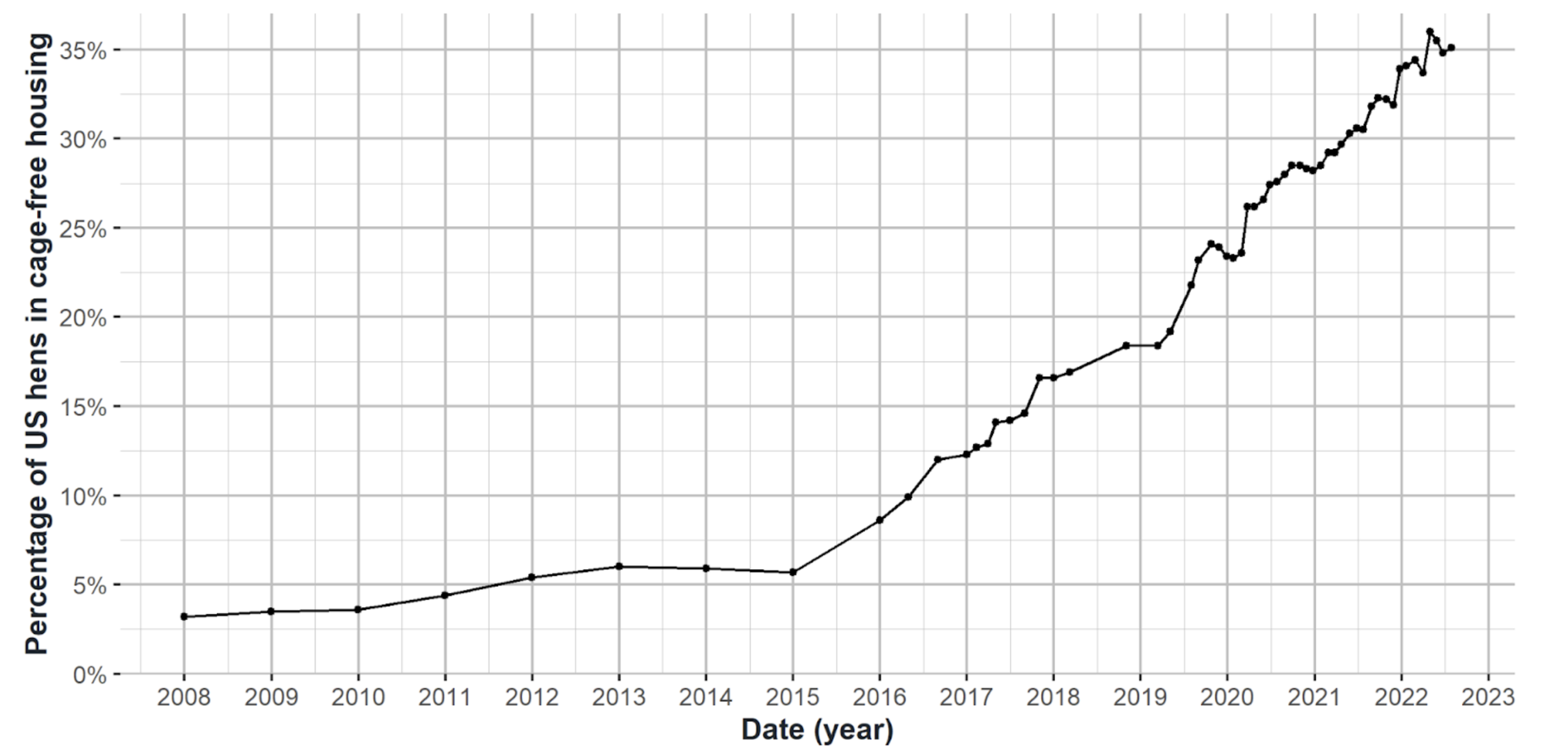
Chart created by Samara Mendez, data available at https://osf.io/z2gxn/
What do we need to transition all egg types—shell, liquid, ingredient?
Yes. A full commitment includes all eggs and egg products (shell, liquid, powdered, frozen, ingredient). Progress may vary by product, so some companies report separately by category while tracking overall progress.
To successfully meet an overall cage-free goal, companies partner with suppliers to make a plan for all food products that incorporate eggs.
Example: In 2025, Sodexo reported 80% of shell eggs, 90% of liquid eggs, and 74% of processed eggs as cage-free in the US, with a goal of reaching 100% for all categories by the end of 2025.