CONSUMER DEMAND
Customers are leading the shift to cage-free eggs—and the evidence couldn’t be clearer.
Additionally, according to the International Food Information Council, 48% of respondents to their 2022 survey indicated that knowing their food was produced with animal welfare in mind was a very important factor in their decision to purchase food/beverages.
Earlier market research has generated similar findings. One 2018 study from Ketchum found that, for the third year in a row, animal welfare was one of the top three concerns among American consumers. Ketchum also reported in 2023 that 72% of Gen Z consumers say that animal welfare is a value they look for when making a food purchase, yet 73% of this cohort think food companies are greedy and only care about profits.
How many consumers does this represent? A survey from Lake Research Partners found that more than three-out-of-four consumers say they are concerned about animal welfare, and 74% of consumers are paying more attention to labels than they were five years ago.
Animal welfare is a top priority
More than ever, shoppers want to know that the eggs they buy come from hens treated with care. Animal welfare has moved from a niche concern to a mainstream expectation, influencing purchasing decisions across demographics.
Two-thirds of US shoppers say animal care is “very” or “extremely” important when buying protein, compared to only about half saying the same for environmental sustainability (Merck Animal Health, 2023).
Animal cruelty ranked #1 among consumer concerns in North America (Innova Market Research, 2022).
Over three-quarters of US consumers are concerned about animal welfare, and 74% of consumers are paying more attention to labels than they were five years ago (Lake Research Partners, 2016).
79% would support their grocery retailer pledging to go 100% cage-free (United Egg Producers/FMI, 2023).
72% of Kroger customers would view their grocery store more favorably if it fulfilled its cage-free commitment, and 60% said they’d be more likely to buy store-brand eggs if they were exclusively cage-free (Data for Progress, 2023).
Over five years, consumer packaged goods with ESG claims like “cage-free” experienced disproportionate sales growth across all price tiers—including private label (McKinsey & NielsenIQ, 2023). The report found that consumers are truly backing their stated ESG preferences with their purchases.
48% of shoppers say that knowing their food was produced with animal welfare in mind is a very important factor in their food and beverage choices (International Food Information Council, 2022).
For three years in a row, animal welfare has ranked as one of the top three concerns for American consumers (Ketchum, 2018).
72% of Gen Z shoppers look for animal welfare as a value when choosing food, yet 73% in this group believe food companies are only motivated by profit (Ketchum, 2023).
Customers back their values with their wallets
People don’t just say they care—they’re willing to pay for it. Market research consistently finds customers will spend more for products that align with their values, especially on animal welfare.
81% want more higher-welfare products, even at a moderate price increase (ASPCA Farm Certification Guide, 2019).
$0.50–$1.16 more per dozen is what consumers will pay for cage-free eggs—well above the 19-cent cost to produce them (Journal of Agricultural and Resource Economics, 2013; Jayson Lusk, professor of Agricultural Economics at Purdue University, 2018).
By 2026, 66% of all shell eggs sold in the US are expected to be specialty eggs—including cage-free, organic, and pasture-raised—more than double the share from five years prior (USDA, 2022).
Cage-free isn’t just the ethical choice—it’s a profitable one, with customers ready to reward companies that take the lead.

Consumer pressure is transforming the egg market, reshaping both what’s on shelves and how companies do business. Rising consumer expectations are driving changes in law, retail requirements, and investment risk. Sales data and expert predictions show the cage-free shift is only accelerating—which means that being proactive on animal welfare is now a reputational safeguard and a strategic advantage.
80% of US consumers would support a state-level ban on confining farm animals in cages (Data for Progress, 2022).
10 US states and the EU have banned cages for egg-laying hens.
Over 50% of consumers in states like Iowa, Wisconsin, Minnesota, New York, and Connecticut support banning battery cage egg production (Faunalytics, 2023).
Standard & Poor’s (S&P) now includes cage-free egg disclosure in its Global Corporate Sustainability Assessment Questionnaire (2021).
The Sustainability Accounting Standards Board requires companies to disclose the percentage of cage-free shell egg sales in their reporting, highlighting that companies prepared for this shift may gain market share by leading on compliance and animal welfare (2017).
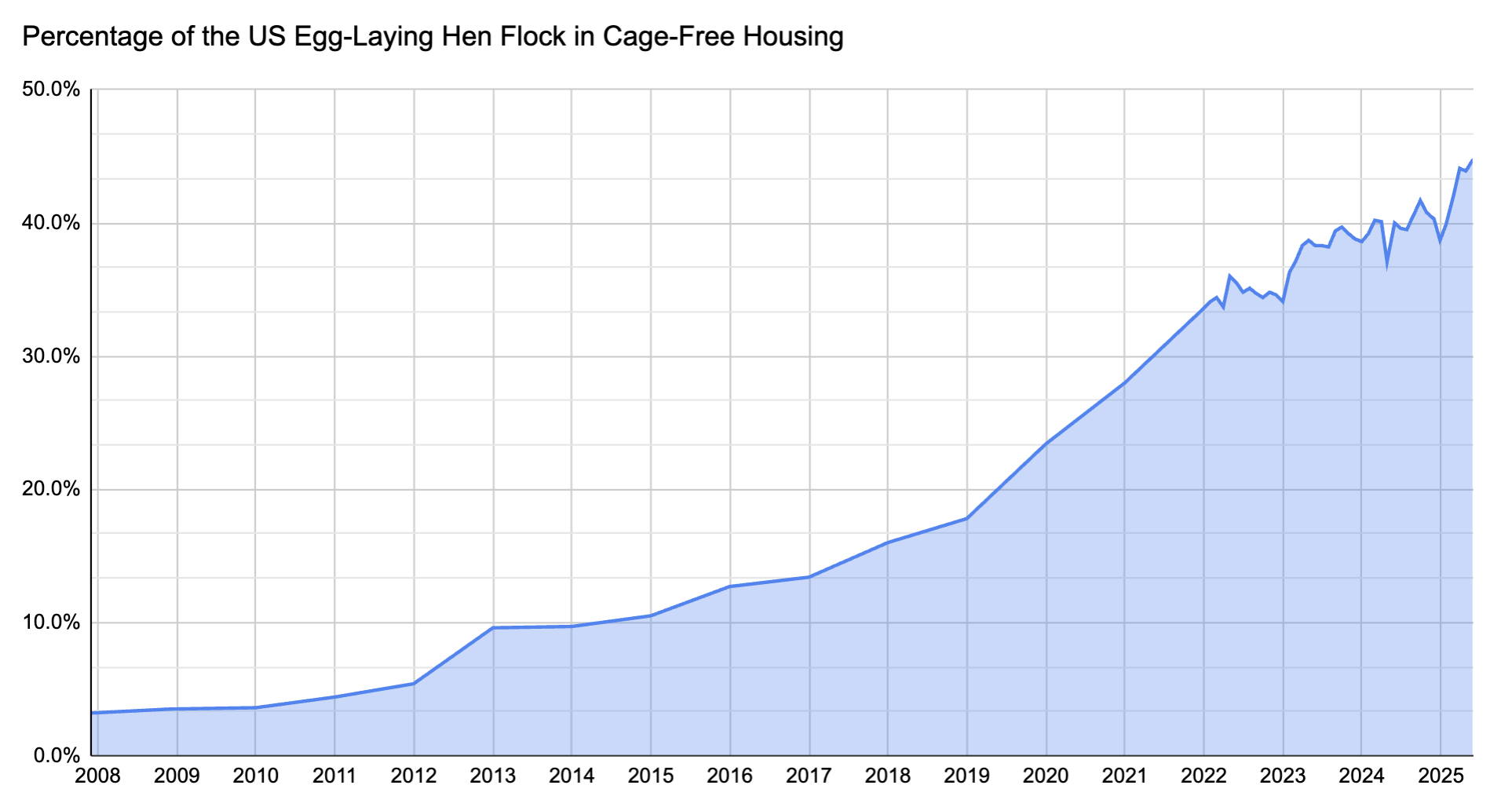
In the past ten years, the share of cage-free eggs in the US market has jumped from 12% to 45% (USDA, 2015–2025).
Both consumers and major market influencers—from regulators to investors—are accelerating the transition to cage-free. Companies that act now can lead the market and build reputational strength.